221 Prospect Street.
1857Carpenter Italianate
The Story
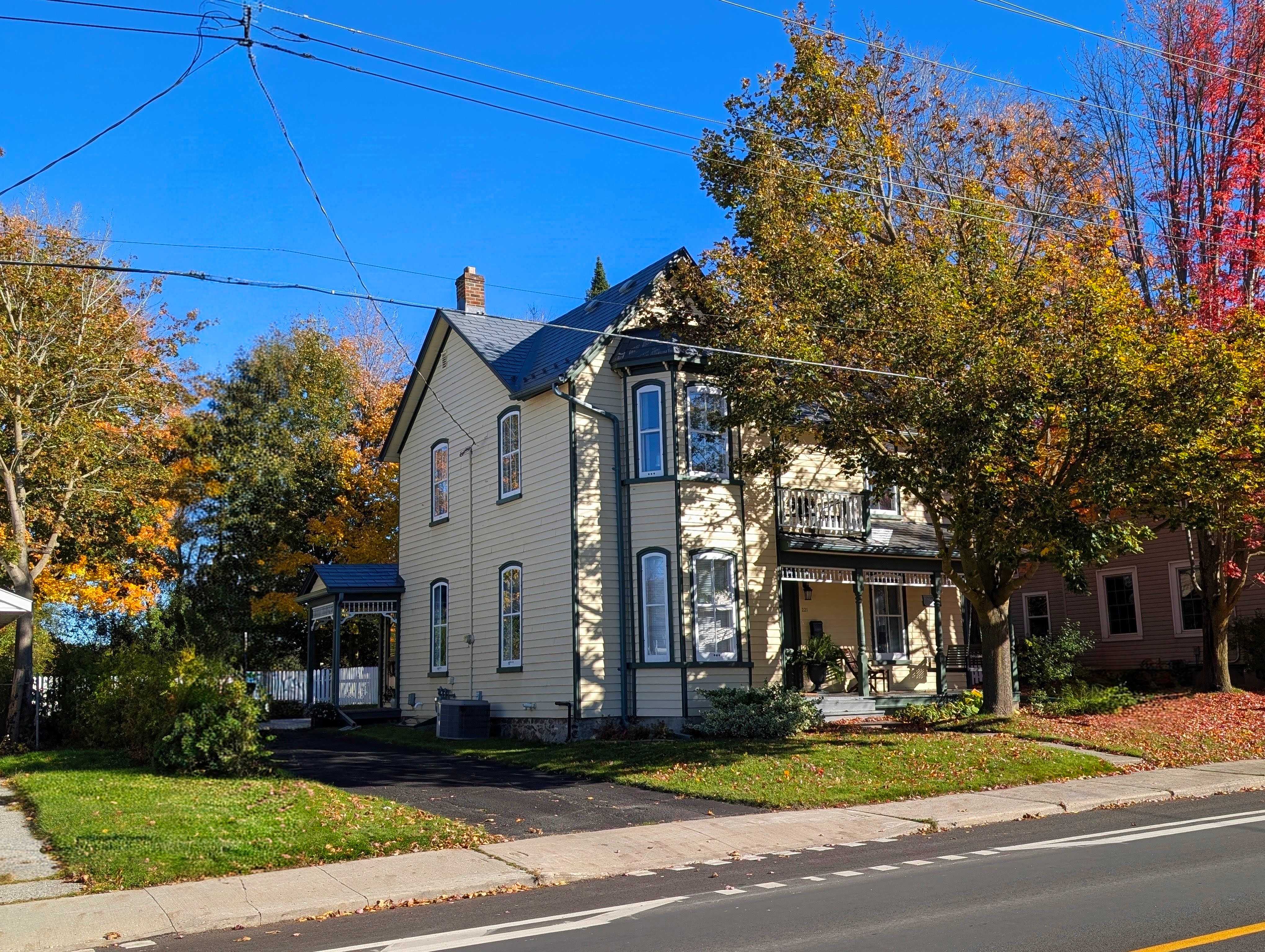
Before it was 221 Prospect Street, this was a house on Garbutt Hill. Its wooden walls and picturesque roofline belong to the years when Newmarket’s east side was taking shape as a community of its own, across the Holland River from Main Street.
The Town of Newmarket identifies John William Marsden as the builder, and the heritage plaque on the house dates its construction to 1857. The Town describes the building as Carpenter Italianate, a local interpretation of the Italianate fashion that spread across Ontario in the middle decades of the nineteenth century. Designs found in architectural pattern books could be adapted by local carpenters and built in wood from readily available materials.
The house still shows what made that style appealing. Tall, narrow windows, a projecting bay, ornamental porch trim and an irregular roofline give the frame dwelling a more elaborate silhouette than its materials might suggest. It brought something of the fashionable villa to an emerging village street, without needing to be a grand brick mansion.
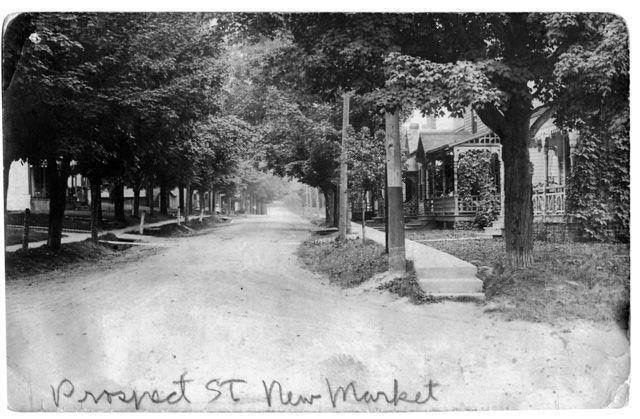
The street outside had its own identity. Garbutt Hill took its name from Thomas Garbutt, an early local carpenter whose house and workshop stood near what is now Gorham Street. Shops, workshops, houses and a Methodist church helped make the east-side settlement a rival to the older centre across the river. In 1886 a municipal by-law joined Garbutt Hill and Robinson Street under the name Prospect Street.
That change in name is important when looking backward. A house known today by a street number may appear in early records under Garbutt Hill, a lot description or an owner’s name. The building survives amid the much-altered streetscape, carrying something of that earlier settlement into modern Prospect Street.


02A street across time
Then & Now

The Man
Builder · miller · merchant · civic figure
John William Marsden
John William Marsden was born in Yorkshire, England, and spent more than a decade in the United States before settling in Newmarket in 1853. He had emigrated as a young man, married in Massachusetts and lived for a time in New York. In Newmarket he first worked in connection with the Woollen Mills, then established himself as a grain and produce merchant.
His business expanded with the town. By the 1860s he was sending large quantities of grain to American markets. Ethel Trewhella records that in 1864 alone he forwarded 7,500 bushels of fall wheat to New York. Marsden went on to become one of Newmarket’s substantial mill owners.
His interests extended far beyond commerce. Marsden served on Newmarket Council and the Public School Board, took an active part in the Methodist church and became involved in the town’s public affairs. Following Abraham Lincoln’s assassination in 1865, he was one of four men chosen to speak at a crowded memorial gathering in Mechanics’ Hall.
By his later years, Marsden had exchanged his earlier Prospect Street surroundings for the Main Street hill. In 1874 he purchased a substantial brick Italianate residence at 115 Main Street South, built the year before by John W. Hughes. That house later became known as the Robertson House, after lawyer and Newmarket mayor Thomas Jaffery Robertson. It was a different building from the earlier house on Prospect Street, and another chapter in Marsden’s Newmarket life.
In 1875, fire destroyed Marsden’s flour mill, with the loss reported at about $22,000. He rebuilt on the same site on a larger scale. When he died in Newmarket in 1878, his obituary recalled an independent and forthright man whose loss was widely felt in the community. One sentence captures something of his character:
“What he said he meant, and what he meant he said.”
— Newmarket Era obituary, 1878
04Dates of Note
A Historical Timeline
John W. Marsden arrives in Newmarket after more than a decade in the United States and becomes involved with the Newmarket Woollen Mills.
The heritage plaque on the house dates the Marsden residence to 1857. The documentary source for this precise year is still being traced.
Marsden is serving on Newmarket Council and is among the speakers at the town’s public memorial for Abraham Lincoln.
Marsden takes a prominent role in the meeting that leads to the establishment of Newmarket’s public cemetery.
Marsden’s flour mill is destroyed by fire; he rebuilds on the same site with a larger operation.
John W. Marsden dies in Newmarket. His obituary remembers a prominent businessman, civic figure, school trustee and Methodist.
Garbutt Hill and Robinson Street are joined under the name Prospect Street.
221 Prospect Street is designated under the Ontario Heritage Act by By-law 2009-99.
Heritage recognition
A Carpenter Italianate survivor.
Its frame construction reflects the Carpenter Italianate style popular in mid-nineteenth-century Ontario. The house is an important surviving link to the early residential development of Garbutt Hill.
Associated with mill owner John W. Marsden, the house was designated under the Ontario Heritage Act on December 14, 2009, through By-law 2009-99.
Read the heritage registerResearch
Sources & notes
Town of Newmarket, Municipal Register of Properties Designated Under the Ontario Heritage Act
Entry for 221 Prospect Street, p. 32 of the April 2025 register. Lists By-law 2009-99, adopted December 14, 2009; describes the Carpenter Italianate construction and identifies John W. Marsden as the builder. Does not provide a precise construction year.Richard MacLeod, “Two Sides of Newmarket, Split by Prospect, Once Competed for Prominence”
NewmarketToday, July 24, 2021. Documents Garbutt Hill, the east-side settlement and the 1886 by-law uniting Garbutt Hill and Robinson Street under the Prospect Street name.Ethel Willson Trewhella, History of the Town of Newmarket
Written in the 1950s and published in 1967. Historical account of Newmarket and its nineteenth-century commercial development, including the record of Marsden’s grain trade. The linked Newmarket Public Library notice describes its digitization.Newmarket Era, obituary of John William Marsden (1878)
Contemporary obituary quoted in the biographical research for this entry, including the description of Marsden’s directness. A stable public digital facsimile has not been identified.Robert Terence Carter, Stories of Newmarket: An Old Ontario Town
Carter’s account of Marsden and his later residence in a brick mansion on the Main Street hill provides biographical context; it is read alongside the Town’s property designation records.Town of Newmarket, designation record for 115–117 Main Street South
Municipal register, By-law 1988-143. Identifies the 1873 brick house as built by John W. Hughes, purchased by Marsden and later associated with Thomas Jaffery Robertson. This is a separate property from 221 Prospect Street.Town of Newmarket, Historic District Walking Tour, stop 14
The Town’s walking-tour brochure identifies the Robertson House at 115 Main Street South and its connection to Marsden. Consulted from the archived brochure.Heritage plaque at 221 Prospect Street
The date 1857 appears on the property’s plaque. That date is distinguished from the Town’s designation register, which does not independently state a construction year.
About the construction date
The plaque mounted on the house gives 1857, while the Town’s heritage designation identifies John W. Marsden as its builder without specifying a construction year. The plaque date is retained in this entry with that distinction in mind.
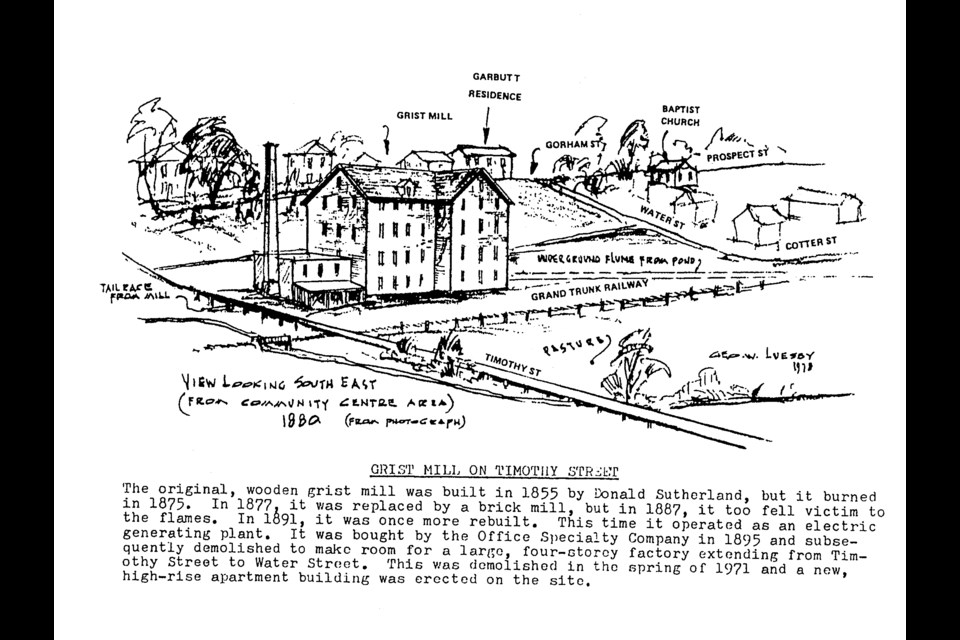
Images. George Luesby’s drawing is based on a circa 1880 photograph of the Timothy Street grist mill. The Prospect Street photograph is catalogued as circa 1910s by the Newmarket Historical Society Archives. The present exterior photograph comes from a 2026 property listing.
Historical record · House 003